COPYRIGHT © 2020 MELTON P.C.C.


Introduction
"New" St Andrew's became the parish church for Melton in June 1868. This replaced "Old" St Andrew's which still stands remote from the village centre towards the border with Ufford and is now preserved by The Melton Old Church Society.
At the time of the church's consecration, the principal windows would all have been fitted with clear glass. Over the years, five decorated windows have been generously gifted to St Andrew's; one each at the East and West ends of the church and three smaller lights along the South wall. In addition, a series of dormer windows in clear glass were installed as an further source of natural light to enhance what was originally a rather dark interior.
Acknowledgements
I am grateful to the Suffolk Record Office (Ipswich) for help in researching this project. My thanks are also due to Valerie Derbyshire author of "A Short Guide to St Andrew's, The Parish Church of Melton in the County of Suffolk". In addition I am indebted to members of the congregation at St Andrew's for the photographs which illustrate this short account.
Other sources of reference include:
Colin de la Rue et al:
Melton Hall The House, the grounds and the people who lived there
Blake Robert (1994): Melton - a changing village
Doreen Bartlett
January 2016
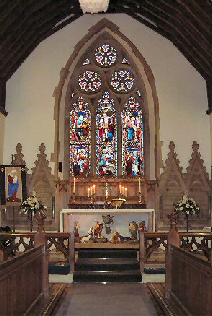
East Window:
This imposing window illustrates the events of Christ's passion set against a bright interlace of red and blue patterns which are continued in the three upper roundels. A full and detailed description can be found in the accompanying extract from Ipswich Journal dated November 1872.
Installed about November 1872 at a similar time to the West Window.
This window was the work of stained glass manufacturers, Ward and Hughes. The company, originally based in Derby before moving to Soho, began in 1836 as Ward and Nixon. Perhaps their most prestigious commission at the time was the re-glazing of the East Window of Lincoln Cathedral.
The work of Ward and Hughes can also be seen in Lichfield and Gloucester Cathedrals as well as locally at Theberton church.
The window, donated by James Packe in 1872 was referred by the congregation for many years as the Packe window. A wall mounted plaque to the left of the window reads:
"This East window was the gift of James Packe 1872."
Notes: James Packe ( 1802 – 1873) was born in Lincoln and educated at Eton & Kings College Cambridge. He married Sarah Martha (Chapman, 1822 -1911), daughter of clergyman. Following a period as Bursar and later Vice Provost at King's College, Mr Packe eventually moved to Melton Lodge as a landowner, gentleman farmer & JP. Mr & Mrs Packe contributed generously towards the cost of the new church and Mrs Packe laid the foundation stone on 29 September 1866. James and Sarah are buried in Melton Old Churchyard.

West Window
This large and imposing window depicts the Ascension. The detail is set out in the accompanying transcript from The Ipswich Journal (December 1872).
Installed in 1872 - this was the second of the five decorated windows and, interestingly, seems likely to have been under construction around the same time as the East Window.
The window is the work of the stained glass firm Heaton, Butler and Bayne (1852 - 1953) of Garrick Street, Covent Garden. Clement Heaton, strongly influenced by Pugin, originally founded his own stained glass firm in 1852. He was joined by James Butler in 1855. Between 1859-61 they worked alongside Messrs Clayton and Bell and were joined by Robert Turnill Bayne, who became their sole designer and a full

partner in the firm from 1862. His windows show strong design and colour, and are often recognisable by the inclusion of at least one figure with Bayne's personal features and long beard. Other examples of Bayne's designs can be found locally at Hawstead, Thurston and St James, Bury St Edmunds.
The Ascension window is dedicated to the Reverend Christopher George Watson, Rector of Melton 1814 - 1870. The memorial inscription reads:
" To the Glory of God , and in affectionate remembrance of Christopher George Watson, late Rector of the parish, who died February 3rd 1870, this window was erected by his three surviving children, 1872"
Notes: Reverend Christopher George Watson, son of Lt Col Christopher Watson, served Melton as Rector for 56 years. Towards the end of his life and ministry he was successful in finding the will and determination to oversee the move to the new building more conveniently placed to meet the needs of a village now centred around the river, turnpike and railway. Christopher George was married to Elizabeth Lant Bullock of Foulkebourne Hall, Essex; they had four children: Sophia, Juliana, Revd Frederick Watson, and Henry (died aged 16). The family is buried in Melton Old Chuchyard.

The James Packe Memorial Window: the design illustrates the Gospel text "Behold, I stand at the door and knock;" A full description of the window is set out in the accompanying transcript from the Ipswich Journal
dated December 1873.
Installed sometime following the death of James Packe in 1873.
Like the East Window, this smaller window was the work of Ward and Hughes.
The brass engraved inscription fixed below this window reads:
" To the Glory of God, and in loving memory of James Packe of Melton Lodge, who died March 3rd 1873. This window is placed by his widow."
Notes: Following the death of her husband, Sarah Packe moved away from Melton to live in London.
The South Nave Windows

The Woods' Memorial Window: this attractive soft coloured window depicts the three Marys with the Angel at Christ's tomb.
Installed in 1910.
The window is the work of AL Moore.
Arthur Louis Moore was one of nine children of a Clerkenwell clockmaker, and in 1871 he founded, along with a Mr. S. Gibbs, the London company of Gibbs and Moore, glassmakers. In subsequent years Moore seems to have worked on his own, operating as A. L. Moore, Glass Painters and Decorators from premises at 89 Southampton Row, London.
In 1878 Moore was joined by his son Charles Eustace Moore (1880–1956) in 1896, when the company became known as A. L. Moore and Son. Their premises in Bedford Way, Russell Square, London were bombed in 1940, but under C. E. Moore the business continued until 1952.
The South Nave Windows
Over the course of their careers the Moores produced over 1,000 windows in the UK and 100 overseas. Locally a window illustrating Christ in Glory can be viewed at St Mary's, Woodbridge.
The Three Mary's window is dedicated as follows:
"To the glory of God and in loving memory of Richard Wood and Frances Isabella his wife of Melton Hall, erected by their children in 1910."
Notes: The Woods of Melton Hall, a prominent family of solicitors with a practice in Woodbridge, were resident in the village for almost 400 years until 1936. (John) Richard Wood died in 1891. A memorial to him was installed at the expense of his many friends on the wall of the parish church - the first person to be honoured by this means since "New" St Andrew's became the parish church in 1868. Richard's wife, Frances (Fanny) died in 1909. (Lawyer) Woods Lane, the road connecting Melton with the A12, commemorates the Wood family. Richard's brother Lewis Ironside Wood together with three of Richard and Francis' grandsons died in the First World War. All are commemorated on the Melton war memorial in the church grounds and on wall mounted family memorials in St Andrew's. Family graves can be found in Melton Old Churchyard.

The South Nave Windows
Scott Memorial Window
St Andrew/Etheldreda: This window, in a beautiful, compacted setting the apostle St Andrew stands with St Ethelreda (abbess), she bearing a model of Ely Cathedral whose Dean and Chapter are patrons of the living.
Installed following the death of Hugh Stowell Scott in 1903.This is the most recent memorial window.
The window is the work of Kempe and includes his signature wheat sheaf logo.
Charles Eamer Kempe (1837 –1907) was a Victorian stained glass designer and manufacturer. His studios produced over 4,000 windows and also designs for altars and altar frontals, furniture and furnishings, lichgates and memorials that helped to define a later nineteenth century Anglican style. The list of English cathedrals containing examples of his work includes: Chester, Gloucester, Hereford, Lichfield, Wells, Winchester and York. (Wikipedia).

Other examples of windows produced in Kempe's workshop can be viewed locally at Hatcheston.
The inscription reads:
"In honour of God and His Servants Andrew the Apostle and Etheldreda of Ely and in loving memory of Hugh Stowell Scott, who died xixth November mcmiii, this window is dedicated."
Notes: Hugh Stowell Scott (abt 1862 - 1903) was an English novelist writing under the pseudonym of Henry Seton Merriman. Born in Newcastle upon Tyne, he became an underwriter at Lloyd's of London, but then devoted himself to travel and to writing novels, many of which had great popularity. Scott visited India as a tourist in 1877-8 and set his novel Flotsam (1896) there. He was an enthusiastic traveller, many of his journeys being undertaken with his friend and fellow author Stanley J. Weyman. He was unusually modest and retiring in character. He died of appendicitis at the age of about forty at Melton, Suffolk. His widow, Ethel Francis continued to live at Long Springs, Melton following the premature death of her husband.